About
A little about petal graphs
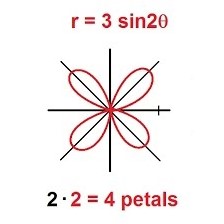
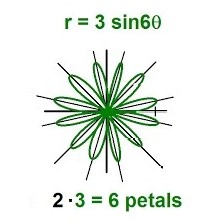
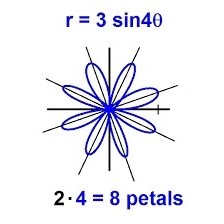
Rose curves or "rhodonea" were named by the Italian mathematician who studied them, Guido Grandi, between the years 1723 and 1728. Graphs of equations in polar coordinates are commonly called petal curves because of their shapes. The number and size of the petals and the petal arrangements are dependent upon the values of a, b, and k.
Flower graphs are quantum graphs built upon non-simple combinatorial graphs consisting of one vertex and any number of loops, or petals, attached to it. In mathematics, a rose (also known as a bouquet of n circles) is a topological space obtained by gluing together a collection of circles along a single point. The circles of the rose are called petals. Roses are important in algebraic topology, where they are closely related to free groups. A rose can have infinitely many petals, leading to a fundamental group which is free on infinitely many generators. The rose with countably infinitely many petals is similar to the Hawaiian earring, although where a Hawaiian earring is compact a rose with infinitely many petals is not compact.